Saturday, November 19, 2005

Quiz Farm: Which theologian are you?

You scored as Augustine. You have a big view of God and also take human sin and depravity very seriously. Predestination is important for you.

Anselm


100%

Augustine


100%

Karl Barth


100%

John Calvin


73%

Friedrich Schleiermacher


60%

Charles Finney


60%

J�rgen Moltmann


47%

Paul Tillich


47%

Jonathan Edwards


33%

Martin Luther


33%

Which theologian are you?
created with QuizFarm.com

Hmm, almost accurate. By the way, I don't think predestination is important to me. ;)

Friday, November 18, 2005

Spammers Giveth?

Image hosted by Photobucket.comSounds familiar? *grin* It's a cute parody of a verse from the Bible: "[T]he LORD gave, and the LORD hath taken away..." (Job 1:21, KJV) Cool eh? ;)

Thursday, November 17, 2005

Wonka's Chocolate

Image hosted by Photobucket.comWhat bliss! Need I say more? :D Thank you so much for the chocolate! (you know who you are) ;)

Tuesday, November 15, 2005

My Two Cents: The Shadow Proves The Sunshine

"Here's a tune that is a bit different than anything we've done before. ... It ended up being one of my favorite songs on the record. ... I can't wait to play this song live- it feels like it needs to be sung outdoors, against the backdrop of a dark night."
- Switchfoot on The Shadow Proves The Sunshine
Sunset at DUThe Shadow Proves The Sunshine reminds us that on every cloud there is a silver lining. That the fact that we are able to identify what is suffering shows that deep within us (conscious or not) we know that there is an ultimate good out there. And that really we are never on our own... because God is with us.

Thursday, November 10, 2005

The Shadow Proves The Sunshine

by Switchfoot (via Let'sSingIt.com)

Sunshine, won't you be my mother
Sunshine, come and help me sing
My heart is darker than these oceans
My heart is frozen underneath

We Are
Crooked souls trying to stay up straight
Dry eyes in the pouring rain,
When the shadow proves the sunshine,
the shadow proves the sunshine

Two scared little run aways
Hold fast till the break of daylight where,
The shadow proves the sunshine,
The shadow proves the sunshine

O, Lord, why did you forsake me?
O, Lord, don't be far away (away)
Storm clouds gathering beside me
Please Lord, don't look the other way

I am a,
Crooked soul trying to stay up straight
Dry eyes in the pouring rain
Where the shadow proves the sunshine,
the shadow proves the sunshine

Two scared little run aways
Hold fast till the break of daylight where,
The shadow proves the sunshine,
The shadow proves the sunshine

Yeah, yeah!
Shine on me

Yeah, yeah!
Shine on me

Yeah, yeah!
Shine on me

Yeah, yeah!
(shine on me)


(Oh!)

(Oh!)

(Oh!)

We're,
Crooked souls trying to stay up straight
Dry eyes in the pouring rain
Where the shadow proves the sunshine,
the shadow proves the sunshine

Two scared little run aways
Hold fast till the break of daylight where,
The shadow proves the sunshine,
The shadow proves the sunshine

Yeah, yeah (the shadow proves the sunshine)
Shine on me (the shadow proves the sunshine)

Yeah, yeah (the shadow proves the sunshine)
Shine on me (the shadow proves the sunshine)

Yeah, yeah (the shadow proves the sunshine)
Shine on me (the shadow proves the sunshine)

Shine on me, (the shadow proves the sunshine)
Let my shadows prove the sunshine (the shadow proves the sunshine)

---

:: Now streaming in Radio.Blog ::

P/s: I would love to read your intepretation of the song in the comments section :)

Wednesday, November 02, 2005

Thoughts on the Exorcism of Emily Rose

Emily Rose truly exemplifies the verse...

"...we know that in all things God works for the good of those who love him,
who have been called according to his purpose."

(
Romans 8:28)

Wednesday, October 12, 2005

"Why do people pray to saints?"

Why do people pray to saints? Do each patron saint have their own prayer? Is it better to pray to saints then to God himself?
-Centerpide
Definition for the word "pray" (according to Dictionary.com)
  1. To utter or address a prayer or prayers to God, a god, or another object of worship.
  2. To make a fervent request or entreaty.
  3. To utter or say a prayer or prayers to; address by prayer.
  4. To ask (someone) imploringly; beseech. Now often used elliptically for I pray you to introduce a request or entreaty: Pray be careful.
  5. To make a devout or earnest request for: I pray your permission to speak.
  6. To move or bring by prayer or entreaty
Image hosted by Photobucket.comBased on the definition above, Catholics do pray to the saints to request/implore/beseech the intercession of these people of God but never as worship. "Praying to the saints" come from the the understanding that we are part of the body of Christ (i.e. His Church) and that we pray for one another (James 5:13-18). And saints too are part of the body of Christ, therefore they are also able to pray for us. The only difference is that saints are already united with the Lord (which is a bonus point for those they are praying for; as Scripture says: [the] prayer of a righteous person is effective; James 5:16)! If we know of certain Christian on earth who seem to have special power because of their great faith/holiness, imagine how much more powerful and effective are the prayers of those who are already in heaven!

Let's move on to...
What is a patron saint?
Patron saints are chosen as special protectors or guardians over areas of life. These areas can include occupations, illnesses, churches, countries, causes -- anything that is important to us. The earliest records show that people and churches were named after apostles and martyrs as early as the fourth century. Recently, the popes have named patron saints but patrons can be chosen by other individuals or groups as well. Patron saints are often chosen today because an interest, talent, or event in their lives overlaps with the special area. For example, Francis of Assisi loved nature and so he is patron of ecologists. Francis de Sales was a writer and so he is patron of journalists and writers. Clare of Assisi was named patron of television because one Christmas when she was too ill to leave her bed she saw and heard Christmas Mass -- even though it was taking place miles away. Angels can also be named as patron saints. A patron saint can help us when we follow the example of that saint's life and when we ask for that saint's intercessory prayers to God.
I am not sure whether each patron saints have prayers of their own but I know well known ones like St. Jude do. :)

Last but not least, please remember that the practice of praying to the saints is just to "supplement" our prayer to God and it can never substitute prayer and worship due only to God Himself. Also do bear in mind that all Christian prayer (whether it's from the Blessed Virigin Mary/saints in heaven/Christians on earth) is directed to God our Father through Jesus Christ His Son who is the "one mediator between God and men" (1 Timothy 2:5)

Friday, September 30, 2005

Movie of the Month: Cinderella Man

Image hosted by Photobucket.com
Cinderella Man is a wholesome slice of old-fashioned Americana, offering welcomed relief from the shallowness of many summer blockbusters. In dramatizing the legendary Depression-era comeback of impoverished boxer Jim Braddock, director Ron Howard benefits from another superb collaboration with his A Beautiful Mind star Russell Crowe, whose portrayal of Braddock is simultaneously warm, noble, and tenacious without resorting to even the slightest hint of sentimental melodrama. The desperate struggle of the Depression is more keenly felt here than it was in Seabiscuit, and Howard shows its economic impact in ways that strengthen the bonds between Braddock, his supportive wife (Renée Zellweger) and three young children, and his loyal manager (Paul Giamatti); all are forced to make sacrifices leading up to Braddock's title bout against heavyweight champion Max Baer (Craig Bierko) in one of greatest boxing matches in the history of the sport. Boasting the finest production design, cinematography and editing that Hollywood can offer, this is a feel-good film that never begs for your affection; it's just good, classical American filmmaking, brimming with qualities of decency and fortitude that have grown all too rare in the big-studio mainstream


I believe a good movie touches the heart strings of its audience and this movie did just that. Cinderella Man will make you laugh, cheer or at least shed a tear. ;) Watching this movie is truly money well-spent. :)

Wednesday, September 28, 2005

The Exorcism of Emily Rose

by Father Brian Harrison, O.S.


Image hosted by Photobucket.comDear friends,

Some of you may have seen over the last year or so that I have sounded the alarm in several Catholic magazines about a couple of viciously anti-Catholic movies disguised as "history" : "King Arthur" (2004) and "Kingdom of Heaven" (2005).

I have just been to see another new movie about the Church, with the full expectation of being provoked into circulating yet another "thumbs-down" warning about it among people like yourselves.

Well . . . Halleluia! Would you believe that that particular expectation of mine has just been smashed - astonishingly, wonderfully! - into smithereens? Can anything morally or spiritually good come out of Hollywood - especially in this day and age, more than half a century after the "good old" days when some movie moguls were (putatively at least) "on our side"? To my utter amazement, I now have to admit that the answer is 'Yes"! Divine grace - actual if perhaps not yet necessarily sanctifying - may be having its effect even in Tinseltown!

Ever since the big box-office success of the original version of "The Exorcist" more than thirty years ago, exorcism-flicks have become a sort of sub-division of the horror movie genre. Most of them have been pretty trashy, depending mainly on sensational special effects and frequently embodying malicious and embarrassingly ignorant caricatures of Catholic beliefs, rites and practices.

Not this time. "The Exorcism of Emily Rose" gets it right. Scarily, yes, but at the same time beautifully, powerfully - inspiringly. This one is the real thing, folks. (I speak as a priest who has had direct experience with real-life exorcisms: in Rome, with Fr. Gabriel Amorth, the Pope's leading exorcist and author of several books on the subject.)

Like "The Exorcist", "Emily Rose" has its basis in a true case-history, but is far superior to the former movie in just about every respect. It's about a 19-year-old American girl from a conservative/traditionalist Catholic family, who becomes possessed and eventually dies in that state after an unsuccessful exorcism. The family's parish priest who attempted the exorcism, Fr. Richard Moore, is then charged with criminal negligence leading to her death. This is because, having being totally entrusted with Emily's welfare by her devout family after psychiatric treatment and medication has proved fruitless, the priest decided to suspend all natural treatments in order to rely on the spiritual power of Christ and His sacred priesthood.

That forensic context alone makes fascinating watching for those who - like most of you reading this - are very conscious of the exclusion of Christ's social kingship from modern societies dominated by the "wall of separation" between Church and State. The superbly acted and directed court scenes in "Emily Rose" present a kind of microcosm of this radical internal conflict at the heart of post-Enlightenment Western culture. They effectively portray the legal dilemma that now arises when an officially agnostic political/judicial system is forced to come to grips with evidence that radically calls in question the secularist orthodoxy which dogmatizes that all possible events must - at least in the public, civil forum - be explained in terms of natural, scientific laws. This dilemma is highlighted in the gripping, brilliantly-written, dialogue confrontations between Fr. Moore's defense counsel (Laura Linney) and the prosecutor bent on persuading the jury that the priest's "archaic superstitions" were responsible for the girl's death. And the drama is ingeniously heightened by the paradox that while this publicly secularist prosecutor boasts that he is privately a "man of faith" (have we heard something a little like that before?), Fr. Moore's attorney has to openly admit that she's personally an agnostic. (The screenplay throughout this movie is excellent.)

That old "with-'religious'-friends-like-these-who-needs-enemies?" scenario will certainly resonate with the so-often-frustrated experience of so many of us traditionally-inclined Catholics in recent decades. A further touch of the same post-conciliar realism comes to light quickly when we learn that the accused Fr. Moore, an honest-to-goodness, orthodox Catholic priest, finds the rug being pulled out from under him by - you guessed it! - the modernist, politicking archdiocesan chancery officials who don't really believe in all that stuff about the devil and possession, and are just plain embarrassed by the whole business! (Yes, folks, this decidedly non-liberal script is actually coming from an 'establishment' Hollywood movie! Mel Gibson had nothing to do with it.)

As a matter of fact, Fr. Moore (played by Tom Wilkinson) comes across as more than just an honest-to-goodness, orthodox priest (wearing his clerical suit and collar whenever he's out of his prison uniform). He's an exemplary, prayerful priest. A holy priest. A traditional priest who knows how to talk back sternly in Latin when the demon croaks at him mockingly in the Church's language. He is quietly dignified in his humiliation in prison and in court. This priest manifests true Catholic pastoral charity and zeal for souls, and a Christ-like willingness to sacrifice his own temporal reputation and freedom for the sake of telling the truth about Emily. Moreover, Wilkinson's portrayal of this character is totally credible, with his acting rising to a superb level in the last court-room scene where he gives his final testimony about Emily. For my money, Wilkinson's Father Moore - here in the dark Third Millennium, no less! - is a thousand times better than Bing Crosby's superficial "cool", crooning priest characters from the supposed golden days of the 'forties and 'fifties. In short, this was a film that left me feeling proud to be wearing my Roman collar as I exited the theater!

Even though the Catholic-influenced Legion of Decency which vetted movies back then has long since disappeared, "Emily Rose" has no foul or blasphemous language (even though it's about demonic possession), no sex, and no nudity. So the most deeply traditional Catholic parents can see, and allow their kids to see, this film, provided only that the latter are old enough not to be traumatized by the scary scenes. Indeed, such families will empathize with the Rose family, whose devout, orthodox Catholic convictions are treated with sympathy and respect throughout the film.
Maybe you are thinking by now that in spite of all these merits, "Emily Rose" still sounds overall like a pretty depressing movie: after all, we're talking about a FAILED exorcism which ends in the hideous death of the possessed girl. If that's what you're thinking, then never fear! You should know that there is a simply wonderful, profoundly moving, surprise ending to the film which puts that whole scenario in a totally unexpected, supernatural light. I assure you you'll leave the theater after seeing "Emily Rose" with your faith strengthened, your spirit elevated - and probably with tears welling in your eyes. All the more so because we assured at the end that this story is basically history, not fiction.

One final comment. I said above that Mel Gibson had nothing to do with this movie. On second thoughts, maybe he did - unwittingly. Could it be that the box-office success of "The Passion" last year is finally getting the message through to some Hollywood studios that there is a huge potential market out there for films which respect, rather than ridicule, traditional religion? If so, we traditional religionists should confirm this message for them by going to see "The Exorcism of Emily Rose". I urge you not to miss it - and take your older children along too. As far as I'm concerned it is a masterpiece: one of the finest and most moving films I've ever seen in my life, and indeed, a worthy companion to "The Passion of the Christ".

Blessings and best wishes,
Fr. Brian Harrison, O.S.

---

Monday, September 26, 2005

Is Confession Biblical?

The Catholic sacrament of penance and reconciliation is the method given by Christ to the Catholic Church by which individual men may confess sins committed after baptism and have them absolved by a priest. This sacrament is known by many names, including penance, reconciliation, and confession (Catechism of the Catholic Church, Sections 1423-1442). However, because confession is only one aspect of the sacrament, it is no longer officially called "confession." Official Church publications always refer to the sacrament as "Penance and Reconciliation," or shorten it to "penance" or "reconciliation."


  1. Let's turn to 1 John 1:9

    "If we confess our sins, he is faithful and just and will forgive us our sins and purify us from all unrighteousness." (NIV)

    Now let's turn to James 5:16

    "Therefore confess your sins to each other and pray for each other so that you may be healed. The prayer of a righteous man is powerful and effective." (NIV)

    For starters, based on the verses above we are able to infer that confession of sins to one another is important for the forgiveness of sins.

  2. Let's turn to Matthew 9:6-8 (in context: Matthew 9:1-8)

    "But so that you may know that the Son of Man has authority on earth to forgive sins...." Then he said to the paralytic, "Get up, take your mat and go home." And the man got up and went home. When the crowd saw this, they were filled with awe; and they praised God, who had given such authority to men." (NIV)

    Why did Jesus made a reference to His humanity (Son of Man) instead of His divinity (Son of God) as He was making known to His followers His authority to forgive sins? Because Jesus wanted His followers to know that mere men too has been given the authority to forgive sins. "When the crowd saw this, they were filled with awe; and they praised God, who had given such authority to men" (Matthew 9:8), the crowd understood Jesus and praised God.

    Question: Who are these people that has been given the authority to forgive sins?

    NOTE: While it is true that Jesus commanded his followers to forgive one another (Matthew 6:14; Matthew 18:21-22; Luke 17:3-4) it is also true that He gave special authority to a group of chosen ones (whom we will examine in the following point), to forgive sins in God's name.

  3. Let's turn to John 20:21-23

    "Again Jesus said, "Peace be with you! As the Father has sent me, I am sending you." And with that he breathed on them and said, "Receive the Holy Spirit. If you forgive anyone his sins, they are forgiven; if you do not forgive them, they are not forgiven."" (NIV)

    The verses above illustrate Jesus appearing to His disciples (i.e. the apostles) and sending His disciples to forgive sins; just as how God the Father had sent Him to forgive sins during His time on earth. (To further affirm the fact that Jesus gave the apostles the authority to forgive sins, please turn to Matthew 18:18.)

    Because the Roman Catholic Church is an apostolic church (i.e. we have an unbroken line of priestly order that has been passed down since the time of the apostles); until today priests has the authority (that Christ gave) to forgive sins.

So the answer is:
Yes, Confession (a.k.a. the Sacrament of Reconciliation) is Biblical. :)

Friday, September 23, 2005

Universalis: Online Liturgical and Devotional Resources

Image hosted by Photobucket.comI am pleased to present you the Universalis; a Catholic site packed with liturgical AND devotional resources. My personal faves are Morning Prayer, Evening Prayer and Night Prayer! Ah... perfect during dry spells of prayer life. ;) Simply wonderful!

Wednesday, September 21, 2005

"He Rescued Me"

Image hosted by Photobucket.comEarlier this evening I was at The Starhill Gallery attending Gillian Tan's talk on Recognizing Angels, organized by The Photographers' Gallery. One of the photos featured was entitled "He Rescued Me" (i.e. the photo attached to this entry), which has a story behind it: about how God saved a man who called out to Him in his time of desperation.


P/S: Incidentally this story was also published in the papers August last year.

Tuesday, September 20, 2005

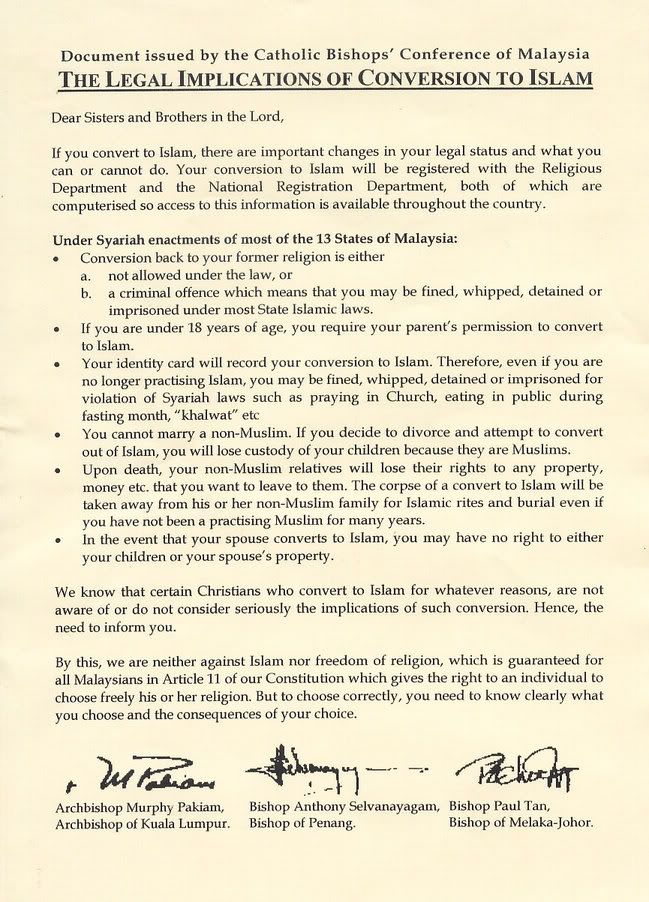
THE LEGAL IMPLICATIONS OF CONVERSION TO ISLAM

Document issued by the Catholic Bishops' Conference of Malaysia
THE LEGAL IMPLICATIONS OF CONVERSION TO ISLAM

Dear Sisters and Brothers in the Lord,

If you convert to Islam, there are important changes in your legal status and what you can or cannot do. Your conversion to Islam will be registered with the Religious Department and the National Registration Department, both of which are computerised so access to this information is available throughout the country.

Under Syariah enactments of most of the 13 States of Malaysia:
  • Conversion back to your former religion is either
    a. not allowed under law, or
    b. a criminal offence which means that you may be fined, whipped, detained or imprisoned under most State Islamic laws.
  • If you are under 18 years of age, you require your parent's permission to convert to Islam
  • Your identity card will record your conversion to Islam. Therefore, even if you are no longer practising Islam, you may be fined, whipped detained or imprisoned for violation of Syariah laws such as praying in Church, eating in public during fasting month, "khalwat" etc
  • You cannot marry a non-Muslim. If you decide to divorce and attempt to convert out of Islam, you will lose custody of your children because they are Muslims.
  • Upon death, your non-Muslim relatives will lose their rights to any property, money etc. that you want to leave to them. The corpse of a convert to Islam will be taken away from his or her non-Muslim family for Islamic rites and burial even if you have not been a practising Muslim for many years.
  • In the event that your spouse converts to Islam, you may have no right to either your children or your spouse's property.

We know that certain Christians who convert to Islam for whatever reasons, are not aware of or do not consider seriously the implications of such conversion. Hence, the need to inform you.

By this, we are neither against Islam nor freedom of religion, which is guaranteed for all Malaysian in Article 11 of our Constitution which gives the right to an individual to choose freely his or her religion. But to choose correctly, you need to know clearly what you choose and the consequences of your choice.

[Signed by Archbishop Murphy Pakiam, Archbishop of Kuala Lumpur; Bishop Anthony Selvanayagam, Bishop of Penang; Bishop Paul Tan, Bishop of Melaka-Johor]

Sunday, September 18, 2005

Blessed Mid-Autumn Festival

The following is a song I tried googling but to no avail; but thank God(!) I found it in my songbook. :) So here is the lyrics (with chords) for those of you who were looking for it. Hehe. Enjoy!

---

UMPAMA BULAN


E_____________E_C#m_ A_B7
Pom pom pom pom ....
E______C#m ________A B7 __E __C#m A B7
Umpama bulan yang menerangi malam
E_C#m_______A ___B7 _E __C#m_A_B7
Begitulah kasih Yesus pada kita

A__________ B7
Dia menerangi hidup kita
__E ______C#m ___________A
Sepanjang perjalanan ... oh .. oh .. oh!
_________B7
Dia datang m'mbri cahaya
E ___________ C#m _ A __B7
Untuk membawa kita ke alam...
_______E _C#m_A_B7
Yang sempurna

Pom pom pom pom ....

Friday, September 16, 2005

Homesick

LanternsAs the Mid-Autumn Festival draws near, this sense of nostalgia came upon me and I started to feel quite homesick... *sigh* I miss my parents.

Wednesday, September 14, 2005

Triumph of the Cross

by CatholicCulture.com

This feast was observed in Rome before the end of the seventh century. It commemorates the recovery of the Holy Cross, which had been placed on Mt. Calvary by St. Helena and preserved in Jerusalem, but then had fallen into the hands of Chosroas, King of the Persians. The precious relic was recovered and returned to Jersualem by Emperor Heralius in 629. The Breviary lessons tells us that Emperor Heraclius carried the Cross back to Jerusalem on his shoulders. He was clothed with costly garments and with ornaments of precious stones. But at the entrance to Mt. Calvary a strange incident occurred. Try as hard as he would, he could not go forward. Zacharias, the Bishop of Jerusalem, then said to the astonished monarch: "Consider, O Emperor, that with these triumphal ornaments you are far from resembling Jesus carrying His Cross." The Emperor then put on a penitential garb and continued the journey.

Image hosted by Photobucket.comThis day is also called the Exaltation of the Cross, Elevation of the Cross, Holy Cross Day, Holy Rood Day, or Roodmas. The liturgy of the Cross is a triumphant liturgy. When Moses lifted up the bronze serpent over the people, it was a foreshadowing of the salvation through Jesus when he was lifted up on the Cross. Our Mother Church sings of the triumph of the Cross, the instrument of our redemption. To follow Christ we must take up his cross, follow him and become obedient until death, even if it means death on the cross. We identify with Christ on the Cross and become co-redeemers, sharing in His cross.


The Sign of the Cross we make over ourselves before prayer helps to fix our minds and hearts to God. After prayer we make it to keep close to God. During trials and temptations our strength and protection is the Sign of the Cross. At Baptism we are sealed with the Sign of the Cross, signifying the fullness of redemption and that we belong to Christ. Let us look to the cross frequently, and realize that when we make the Sign of the Cross we give our entire self to God — mind, soul, heart, body, will, thoughts.

O cross, you are the glorious sign of victory

Through your power may we share in the triumph of Christ Jesus.
Symbol: The cross of triumph is usually pictured as a globe with the cross on top, symbolic of the triumph of our Savior over the sin of the world, and world conquest of his Gospel through the means of a grace (cross and orb).

The Wednesday, Friday and Saturday following September 14 marks one of the Ember Days of the Church. See Ember Days for more information.


Interesting bit:

  • Folklore has that the weather on the Ember Days of this month (September 15, 17, and 18) will foretell the weather for three successive months. So Wednesday, September 15, will forecast the weather for October; Friday, September 17, for November; and Saturday, September 18, for December.

Tuesday, September 13, 2005

Something for you...

Image hosted by Photobucket.comI've added "Building One World"; the 2oth World Youth Day Compilation to my radio.blog as a treat to all of you: faithful readers! :) Hehe. If you like the album, please lend your support by purchasing the CD. In the mean time, enjoy! :D

Thursday, September 08, 2005

Ridiculous Religious Relativist

Last week, I received an SMS from a trusted source who told me a certain Catholic priest from a certain order made the following statement at an inter-religious university students conference:

"Our [Catholic] faith is unique but NOT superior to other religions"


Personally, I find his statement very condescending towards people of other faith groups. Did it ever occur to this particular priest that there are plenty of knowledgeable and well-read individuals from various religions, who are very well aware of the Roman Catholic Church's implicit claim of Her superiority over ALL religions? Take the following statement for example:

"... Christ's Catholic Church alone, ... is the universal help toward salvation, that the fullness of the means of salvation can be obtained"
- Second Vatican Council,
Decree on Ecumenism

Besides the Catechism of the Catholic Church (CCC) further confirms Her claim by stating that the "ultimate truth of God's Revelation" (2071) is the Word of God (i.e. Sacred Scripture AND Sacred Tradition; which by the way can only be found in the Catholic Church which Christ Himself established) And if that is not enough, the Catholic Church also claims to have God leading her toward the fullness of truth (CCC 2625).

So tell me what or rather who can top the superiority of God's revelation?

---

Related posts:

P/S: What do you call "a person who holds controversial opinions, especially one who publicly dissents from the officially accepted dogma of the Roman Catholic Church"? Click here.

Tuesday, September 06, 2005

My Pet Fish


My Pet Fish
Originally uploaded by bookofjohn.
Gonna celebrate Mid-Autumn Festival with my cell group on the 18th of September! YAY! :) Really excited about the whole thing. Reminds me of the good ole' days when I was still a lil' kid staying in Kampung Kebun Teh. *ahh...* :)

Thursday, September 01, 2005

More World Youth Day Memorabilia!

Image hosted by Photobucket.com JOY! I was at the Youth Centre this afternoon and I was pleasantly surprised when Brother Alberto gave me these memorabilia from the 2005 World Youth Day! Thanks Brother! :) Just in case you were wondering: the badge says "We Are Pope's" (in German) and the wristband has the words "20th World Youth Day Cologne 2005" embossed on it. Ah... more stuff to add to my Catholic collection. :D

Saturday, August 27, 2005

HEAVEN: Christians Only?

As promised I will reply to questions that were posted as comments on my previous entry.

---

"Suppose there are two guys. One's nice old Mr Lim. Mr Lim has been a devout Buddhist all his life. He works as a maths teacher in primary school and loves nurturing young minds. He is a vegetarian, he is a devout husband to his wife and a caring father to his children. He also helps other less fortunate people through charities in his free time.

Now supposed that the other guy is Adolf Hitler. He murdered millions of innocent people and he allowed his army to rape and pillage at will. However, let's say that on his death bed, Hitler suddenly and truly saw the errors in his way and repented for all his sins and embraced God, Jesus Christ, and Christianity with all his heart. And I don't mean some desperate bid for salvation, I mean he REALLY and TRULY believed in Jesus and God.

Now my question is, based on Christianity, who goes to heaven and who to hell when both of them dies here? According to my religious Protestant friend, it's gonna be Hitler. All is forgiven. Disbelievers are condemned to hell, no matter what their other attributes and past actions were.

And I definately cannot see the fairness in this."

Dear Cypher,

Thank you for taking the time to post the comment above. I am Catholic and I will do my best to answer your question from the stance of the Catholic Church.

According to the Dogmatic Constituition on the Church: Lumen Gentium, non-Christians can go to heaven if they fulfill these conditions:

  1. "[T]hrough no fault of their own do not know the Gospel of Christ or His Church"
  2. "[S]incerely seek God"
  3. Doing God's will "as it is known to them through the dictates of conscience"

However the third condition is a tricky one to fulfill, because "often men, deceived by the Evil One, have become vain in their reasonings and have exchanged the truth of God for a lie, serving the creature rather than the Creator". What's more Pope Benedict XVI warned that religions which "depend on superstitions or other errors, constitute an obstacle to salvation" (Dominus Iesus, Ratzinger). That is why it is important for us Catholics to proclaim the Gospel to fulfill Christ's Great Commission to us ("Go, therefore, make disciples of all nations, baptizing them in the name of the Father and of the Son and of the Holy Spirit, teaching them to observe all things whatsoever I have commanded you...", Matthew 28:19-20) as well as to help others receive God's salvation. As followers of Christ we must pray for St. Paul's spirit to evangelize, and remind ourselves with his words: "Woe to me, if I do not preach the Gospel" (1 Corinthians 9:16) Having said all these, the Catholic Church does recognize "[w]hatever good or truth..." that is found in other religions.

As for the question whether "Mr. Lim" goes to heaven or hell? I cannot answer that; for who am I to judge one's conscience? I'll leave that up to God. ;) But if "Mr. Lim" does get to heaven, he did so only through the favour and mercy of Our Lord Jesus Christ who is the Way, the Truth and the Life (John 14:6)

God bless.

Friday, August 26, 2005

Catholic Calendar

Image hosted by Photobucket.comKnow when are your feast days, solemnities, memorials, holy days of obligation and more!

CLICK HERE.

Thursday, August 25, 2005

World Youth Day 2005 Rubber Wristband

Image hosted by Photobucket.com
I got this rubber wristband as a souvenir from Adrian who went for the 2005 World Youth Day in Cologne, Germany. He bought it from one of the pilgrims from Bulgaria (?) I'd never buy these wristbands for myself or thought of wearing them (especially those sold by McDonald's; I find them a lil' cheesy), but I just had to wear this one... Why? 'Cause it's just. so. Catholic! :) P/s: did you notice the embossed image of a ten-bead rosary? ;)

Wednesday, August 24, 2005

24th August: St. Batholomew's Day

Image hosted by Photobucket.com
St. Bartholomew was one of the 12 Apostles of Jesus. Bartholomew (Greek Βαρθολομαιος) comes from the Aramaic bar-Tôlmay, meaning son of Tolmay or son of the furrows (perhaps a ploughman).

According to scripture, St. Bartholomew was one of the disciples to whom Jesus appeared at the Sea of Tiberias after the resurrection (John 21:2). He also witnessed the ascension (Acts 1:4, 12, 13).

Tradition has it that after the ascension, St. Bartholomew went on a missionary tour to India, where he left behind a copy of the Gospel of Matthew. In works of art he is often represented with a large knife, or, as in Michelangelo's Last Judgment, with his own skin hanging over his arm, tradition holds that in Armenia he was flayed alive and then crucified with his head upside down. This fate has led to him being adopted as the patron saint of tanners.

Source: Wikipedia.com

Monday, August 22, 2005

Year A: Homily for the 21st Sunday in Ordinary Time

by Father Simon Yong, SJ

Image hosted by Photobucket.comHave you heard of Crab Mentality. It means to pull people down. We don’t like people to be up there—something like misery seeks company. (You know when you’re miserable…you don’t want others to feel good). We like it when people are like us… down here. Today we should be happy because we are to meet one such person: Peter—who is weak like us. It is true that God used him and therefore can use weak individuals like us for his glory but to focus on “Peter being weak like us” is to miss an important fact today.


I want to take a closer look at Peter’s relationship to Jesus and what that means to us as Christians. In the gospel, Peter declared Jesus as Messiah. From here we think in chronological (time) sequence that Peter first declares Christ as Messiah and because Peter is so clever then Christ decides to make Peter be the rock upon which to found the Church. It’s like one after the other. The point I want to make today is that it’s not “first this” and then only “second this”. In fact, I believe that Christ always goes together with Peter. If you want, Peter represents the Church who throughout every age declares Jesus as the Christ. Therefore, one can say that in Peter we have a Petrine ministry whose function is to safeguard the proclamation that Jesus is the Christ. This is why the Pope is called the Servant of the Servants of God. Precisely, his job function is to echo Peter’s answer: You are the Christ. Only then can the office (or the job function) of the Pope make sense. Peter’s ministry and all those who succeed him in the Petrine Ministry are the guarantee of obedience to who Christ is and so to his teachings. That is why that the Church cannot simply do as she likes. If you want; Peter and the Pope are the incarnation of this “obedience”. Let me give an example. During the time of John Paul II, he was asked to change the Church’s teaching on divorce or the indissolubility of marriage. His answer was that the Pope cannot do anything he wants, but he must on the contrary continually rekindle our sense of obedience to the teachings of Christ.


This ministry of the Pope is crucial to the Church’s faithfulness and obedience.


This is where we have trouble and difficulty in believing in this Petrine Ministry because we are disturbed by weakness or perhaps better, we are fascinated by weakness. For example, have you heard of Pope Benedict IX? He was quite scandalous, apparently he became Pope at the age of 11 and not only that for he was 145th, 147th and 150th Pope. Or what about Alexander VI who has always been quoted as one of the most corrupt popes?


The fact is not so much Christ can use weak people but rather that Christ’s power can break through and will always shine through our of human weakness. The Petrine Ministry has existed for 2000 years and what Popes like Benedict IX or Alexander VI had done would have destroyed the Church but they have not. What happened was that those who exercised authority have allowed their humanity to get in the way of their responsibility. Despite that, Christ’s Church has stood. Therefore this speaks more about Christ than about our weaknesses. Therefore, our trust is in Christ’s words: the Church will be built upon Peter and that the power of the underworld can never overcome his Church.


This has implication for us and where I become personal. But it is not an attack of the personal decisions that people have taken. They might have reasons to do so. Yet, I think this where we may make a big mistake. Let me give an example: A misunderstanding with the priest or the parish office staff was very rude and then the person goes to another denomination. I think the person has failed to appreciate Jesus’ promise. I once heard that of this Catholic who proudly proclaimed that she’s now gone to Damansara Utama Methodist Church. The pastor was more happening but most of all they were more accepting. Often people leave the Catholic Church because they have disagreement with Church teachings or with their priests.


Unfortunately this betrays a lack of understanding of the promise of Christ. Put in another way, if there is supposed to be a Church, then the Church of Christ in its fullness cannot be without Peter. The promise of Christ to Peter stands forever, irrespective of whether the Pope is strong or weak. His promise doesn’t become activated when we are weak like the song that is sometime sung: ~You are my strength when I am weak~… No, even if the Pope is strong, Christ would still be his strength.


In conclusion, Christ gave his authority to Peter forever even though every now and then those who exercise this authority let their humanity get in the way of their responsibility. As someone said Christianity is not a collection of truths to be believed or of laws to be obeyed. Rather, Christianity is a person. Christianity is Christ. And therefore the Church must proclaim this person every day in season and out of season and that proclamation is tied to Peter and all his successors who must ensure that the Church does it through her teachings, her celebration and administration. We have something or someone no other religion has… not a celebration of weakness but rather the power of Christ working through human instrumentality.

Feeling Heavy


Sir Brother Sun
Originally uploaded by bookofjohn.

I don't know why my heart feels so heavy for the past week...

Wednesday, August 17, 2005

Testimony of a Prodigal Son

The following is a testimony by a close friend of mine, which I have known since secondary school. Because of the fact that I knew him for such a long time and was with him when he experienced the miracle, I can vouch the authenticity of his testimony. His testimony gave me much encouragement and I pray that it is the same with you too.

God bless.

---

Image hosted by Photobucket.comI have a story to tell. But before that, I would like to tell you a little bit about myself. I am a 20 year old guy whose been a somewhat lapse Catholic for most of my life. I didn’t read the Bible and didn’t really pray that often either.


In my teenage years, I always regarded religion as something unimportant, not real. I thought of it as a hoax made up by man, giving man a reason to make war and conquer other nations. Basically, I did not have any faith in any religion at all. Call me stupid or ignorant, but that was how I thought when I was in my teens.

Although I did not have faith, I somehow still favoured Catholicism above all other religions. Catholicism gave me a sense of being ‘chosen’.

In later years though, when I started working part-time in a shopping mall, I got to know this girl working there. As time went by, I began to fall in love with her. Before I knew it, I had started a relationship with a non-Catholic girl - a 20 year old Malay girl, to be exact. She was the first love of my life and I was her first too.

We really treasured each other deeply. Life was great when we first fell in love – the happiest yet saddest moments of my life were with her at that time. She was very, very nice to me and I believed that no other person of the opposite sex (apart from her and my mother) would ever treat me so well. I was very much attracted to her beauty and her personality. At the time, all I could think of was her. I did not want to lose her. I did not really mind converting to Islam for her, since I was of the opinion that all religions are man-made anyhow. For your information, Malaysia has a law forbidding Moslems to convert to other religions. Those who marry Moslems are required to convert to Islam.

I was prepared to do anything just to be with her as I was very much in love. The only thing I worried about was my family’s disapproval. I even went so far as to plan to ‘disappear’ from my family after completing my studies just to be with her.

But deep down in my heart, my conscience was pricking me, and I felt like something was not right. I needed a definite answer. I needed to know for certain that God really existed and that religion was not man’s creation. At the time, I was Kuala Lumpur (KL) pursuing my degree, yet continuing my relationship with her long distance.

When I was in KL, I contacted a good friend of mine. He told me about this camp organised by Lifeline College & Young Adults Ministry, and he invited me to sign up. At the time, I was not really interested in the camp but my friend insisted that I should go. So, I went to the camp and it was great. I met many Catholic youths and made friends with them. But my ultimate objective was not so much to make friends as it was to make a decision.

During the camp, there was this part known as the Adoration of the Blessed Sacrament – where Jesus is worshipped in the Eucharist. I was desperate for an answer and I lifted up a sincere prayer, asking God to show me a sign that He was real and if He really wanted me NOT to walk away from Him. I told Him that if I were to leave my girlfriend for Him, would He please bless her for me, PLEASE!!

It was very difficult. I could not bear to leave her and I asked God to give me courage and assurance to leave her for Him. I prayed very hard. From sitting on the floor to kneeling down before Him, I was desperate to know Him and I realized, that I felt really lost. I opened myself up to Him.

From where I was kneeling, I could see out of this tinted glass window to a wall. Everyone else was focusing on the Blessed Sacrament but something else caught my eye. I saw this image on the wall through the tinted window. At first, I could see the image of the Virgin Mary , then it changed to the image of Jesus, then back again to the Virgin Mary. It seemed to alternate between the 2 images.

I thought I was imagining it all, and wondered what was happening to me. I was really bothered by the images I saw. The last image I saw was the face of Jesus Christ carrying a cross with a beautiful crown on his head. At the time , I still did not believe that I saw those images - I thought I had imagined it all.

But my vision was confirmed by one of the speakers, known to have the gift of knowledge. He said, "There is one man in this room who did not have faith in Me , who thinks that I do not love him. Fear not, My child, for I have revealed My image to you tonight. Come with Me because I am your Father". When I heard that, I burst into tears. I was so touched, and I felt like a fool for doubting Him.

Finally, after so long, I came to my senses. I felt good. God really came when I sincerely sought Him. I finally understood that He was there all along. He is REAL. He is the Living God, and He is my king. I mean, how wonderful to know that a king would die for all of us at the cross, for all our selfish mistakes that our Father would not want us to repeat. How wonderful it is that a king would sacrifice Himself just for us. I mean, He could have left us in our sin, to spent eternity in hell. But because He loves His people so much, He willingly died for us on the cross to atone for our sins and save us.

And this is how I repay Him? By leaving Him for a girl? NEVER! I finally realised that I must not be selfish. He died on the cross and this is not how I am going to repay Him, not by leaving Him. People are trying to spread the Good News of the Lord and what am I doing, trying to kill the religion? What would happen if everyone were to be as selfish as me? Would there be no Catholics in the world anymore? Would God have then sent His only Son FOR NOTHING?

So…I decided to leave her. And I really did it the next day. I told her that I couldn’t be with her because I couldn’t afford to lose my religion. She understood and didn’t try to change my mind. But we were both sad...those times and memories we shared!

Yet, I did not regret what I did then. And now? It’s been four months already...I am still going strong with my life , trying my best to be a good Catholic. I believe that no matter what happens, the Lord is still with me. I’m trying to seek Him in everything. I believe that if I seek Him sincerely , He will always come to me.

Silver Lining


Silver Lining
Originally uploaded by bookofjohn.
Psalm 150

Praise the LORD.

Praise God in his sanctuary;

praise him in his mighty heavens.


Praise him for his acts of power;

praise him for his surpassing greatness.


Praise him with the sounding of the trumpet,

praise him with the harp and lyre,


praise him with tambourine and dancing,

praise him with the strings and flute,


praise him with the clash of cymbals,

praise him with resounding cymbals.


Let everything that has breath praise the LORD.

Praise the LORD.

Sunday, August 14, 2005

Solemnity of the Assumption

by Catholic Culture

On November 1, 1950, Pius XII defined the dogma of the Assumption. Thus he solemnly proclaimed that the belief whereby the Blessed Virgin Mary, at the close of her earthly life, was taken up, body and soul, into the glory of heaven, definitively forms part of the deposit of faith, received from the Apostles. To avoid all that is uncertain the Pope did not state either the manner or the circumstances of time and place in which the Assumption took place — only the fact of the Assumption of Mary, body and soul, into the glory of heaven, is the matter of the definition.

The Assumption

Image hosted by Photobucket.com
Now toward the end of the summer season, at a time when fruits are ripe in the gardens and fields, the Church celebrates the most glorious "harvest festival" in the Communion of Saints. Mary, the supremely blessed one among women, Mary, the most precious fruit which has ripened in the fields of God's kingdom, is today taken into the granary of heaven. — Pius Parsch


The Assumption is the oldest feast day of Our Lady, but we don't know how it first came to be celebrated.


Its origin is lost in those days when Jerusalem was restored as a sacred city, at the time of the Roman Emperor Constantine (c. 285-337). By then it had been a pagan city for two centuries, ever since Emperor Hadrian (76-138) had leveled it around the year 135 and rebuilt it as Aelia Capitolina in honor of Jupiter.


For 200 years, every memory of Jesus was obliterated from the city, and the sites made holy by His life, death and Resurrection became pagan temples.


After the building of the Church of the Holy Sepulchre in 336, the sacred sites began to be restored and memories of the life of Our Lord began to be celebrated by the people of Jerusalem. One of the memories about his mother centered around the "Tomb of Mary," close to Mount Zion, where the early Christian community had lived.


On the hill itself was the "Place of Dormition," the spot of Mary's "falling asleep," where she had died. The "Tomb of Mary" was where she was buried.


At this time, the "Memory of Mary" was being celebrated. Later it was to become our feast of the Assumption.


For a time, the "Memory of Mary" was marked only in Palestine, but then it was extended by the emperor to all the churches of the East. In the seventh century, it began to be celebrated in Rome under the title of the "Falling Asleep" ("Dormitio") of the Mother of God.


Soon the name was changed to the "Assumption of Mary," since there was more to the feast than her dying. It also proclaimed that she had been taken up, body and soul, into heaven.


That belief was ancient, dating back to the apostles themselves. What was clear from the beginning was that there were no relics of Mary to be venerated, and that an empty tomb stood on the edge of Jerusalem near the site of her death. That location also soon became a place of pilgrimage. (Today, the Benedictine Abbey of the Dormition of Mary stands on the spot.)


At the Council of Chalcedon in 451, when bishops from throughout the Mediterranean world gathered in Constantinople, Emperor Marcian asked the Patriarch of Jerusalem to bring the relics of Mary to Constantinople to be enshrined in the capitol. The patriarch explained to the emperor that there were no relics of Mary in Jerusalem, that "Mary had died in the presence of the apostles; but her tomb, when opened later . . . was found empty and so the apostles concluded that the body was taken up into heaven."


In the eighth century, St. John Damascene was known for giving sermons at the holy places in Jerusalem. At the Tomb of Mary, he expressed the belief of the Church on the meaning of the feast: "Although the body was duly buried, it did not remain in the state of death, neither was it dissolved by decay. . . . You were transferred to your heavenly home, O Lady, Queen and Mother of God in truth."


All the feast days of Mary mark the great mysteries of her life and her part in the work of redemption. The central mystery of her life and person is her divine motherhood, celebrated both at Christmas and a week later (Jan. 1) on the feast of the Solemnity of Mary, Mother of God. The Immaculate Conception (Dec. 8) marks the preparation for that motherhood, so that she had the fullness of grace from the first moment of her existence, completely untouched by sin. Her whole being throbbed with divine life from the very beginning, readying her for the exalted role of mother of the Savior.


The Assumption completes God's work in her since it was not fitting that the flesh that had given life to God himself should ever undergo corruption. The Assumption is God's crowning of His work as Mary ends her earthly life and enters eternity. The feast turns our eyes in that direction, where we will follow when our earthly life is over.


The feast days of the Church are not just the commemoration of historical events; they do not look only to the past. They look to the present and to the future and give us an insight into our own relationship with God. The Assumption looks to eternity and gives us hope that we, too, will follow Our Lady when our life is ended.


In 1950, in the Apostolic Constitution Munificentissimus Deus, Pope Pius XII proclaimed the Assumption of Mary a dogma of the Catholic Church in these words: "The Immaculate Mother of God, the ever-virgin Mary, having completed the course of her earthly life, was assumed body and soul into heaven."


With that, an ancient belief became Catholic doctrine and the Assumption was declared a truth revealed by God.


Fr. Clifford Stevens in Catholic Heritage

Friday, August 12, 2005

Thanksgiving

Image hosted by Photobucket.com

I PRAISE & THANK GOD for helping me pulled through and I pray that He will allow more opportunities for me to praise and thank Him! ;)

Thursday, August 11, 2005

100805: Around 2pm yesterday


On the way to Times Square
Originally uploaded by bookofjohn.

Absolute Truth VS. Philosophical Relativism

"We can't judge which religion is superior than the others. None of us can judge that."
I cannot and I do not agree with the statement above because for us who practice religion we do have a certain degree of biasness towards the religion of our choice. And for most of us, this bias comes from the fact that we believe that our religion is superior compared to others, otherwise we would not be in ANY religion as a matter-of-fact. With all due respect, clearly the person who made the statement above subscribe to the idea of philosophical relativism which is the position that believes there is no such thing as absolute truth.

The fact is there IS absolute truth (i.e. truth that can be applied to anyone regardless whether they believe in it) and a very good analogy of it is:
Gravity
The pull of gravity affects EVERYONE regardless of their belief in its existence.
Christianity subscribes to the idea of absolute truth; as Christians believe that Jesus is our only hope for our salvation for "[s]alvation is found in no one else, for there is no other name under heaven given to men by which we must be saved." (Acts 4:12) and this applies to everyone not only Christians.

To some St. Peter (the one quoted saying Acts 4:12) might sound like a bigot and their immediate response might be:

"Hey, there is no such truth that can be applied to everyone regardless of what they believe in it! (i.e. there is no such thing as absolute truth)"

Well here comes the irony. If what was said in the response was true, then there must be at least one absolute truth, which means the what was said in the response is false!

Therefore to take the stand as to belief there is no such thing as absolute truth is a self-defeating position. The conclusion? It is better to have an absolute truth stand than to have none at all. ;)

Sunday, August 07, 2005

Part 2: Do all religions lead to God?


Image hosted by Photobucket.comThank you people for your honest comments in my previous post! And the conclusion is: almost 66% of the voters are DO NOT agree that all religions lead to God, whereas almost 28% agree that all religions lead to God.

Now, the reason for my provocative post was to know whether most people subscribe to the idea of relgious relativism..

which is the belief that ALL religions are simply different pathways to the SAME ultimate reality.

Anyway as the result suggests, most people (at least the ones visiting this blog) do not subscribe to religious relativism. (thank God!) Seriously, to believe all religions lead to God is a nonsensical stance simply because different religions have different concepts of God. For example in Hinduism God is the universe (pantheism) whereas in Christianity we have the concept of a personal God (the Trinity; the Father, the Son and the Holy Spirit) who knows us by name and loves us. Besides that, the concept of salvation between religions is drastically different. Correct me if I am wrong, in Islam; salvation is to enter into a Paradise of sensual pleasures whereas for in Christianity; salvation is to have conscious personal fellowship with God for all eternity. Oh and by the way, pure Buddhism is atheistic.

So tell me how can one reconcile the idea of religious relativism when the differences are so significant?

Wednesday, August 03, 2005

Survey: Do all religions lead to God?


Do all religions lead to God?
Yes
No
I don't know


Free polls from Pollhost.com

If you would like to comment regarding this topic, please do so in the comment section (the link can be found at the top right hand corner of this entry) :)